

Hey there! As a supplier of HIPS granules, I'm super excited to walk you through the production process of these awesome materials. HIPS, or High Impact Polystyrene, is a widely used thermoplastic known for its excellent impact resistance, stiffness, and ease of processing. So, let's dive right in and explore how these HIPS granules are made.
Raw Material Selection
The first step in the production of HIPS granules is selecting the right raw materials. We start with styrene monomer, which is the primary building block of HIPS. Styrene is a clear, colorless liquid with a sweet smell. It's derived from petroleum and is used in the production of various plastics and resins.
In addition to styrene, we also add a rubber modifier to enhance the impact resistance of the HIPS. The rubber modifier is typically a butadiene-based rubber, such as styrene-butadiene rubber (SBR) or polybutadiene rubber (PBR). The amount of rubber modifier added depends on the desired properties of the final product.
Polymerization
Once we have the raw materials, the next step is polymerization. Polymerization is the process of combining monomers to form polymers. In the case of HIPS, we use a process called emulsion polymerization.
In emulsion polymerization, the styrene monomer and the rubber modifier are mixed with water and a surfactant. The surfactant helps to disperse the monomers and the rubber modifier in the water, forming an emulsion. A catalyst is then added to initiate the polymerization reaction.
The polymerization reaction takes place at a specific temperature and pressure. As the reaction progresses, the monomers and the rubber modifier combine to form long chains of polymers. The resulting polymer is a latex, which is a milky white liquid.
Coagulation and Washing
After the polymerization reaction is complete, the latex is coagulated to separate the polymer from the water. Coagulation is typically done by adding a coagulant, such as calcium chloride or sulfuric acid, to the latex. The coagulant causes the polymer to precipitate out of the water, forming a solid mass.
The solid mass is then washed to remove any remaining impurities, such as the surfactant and the coagulant. Washing is typically done by adding water to the solid mass and stirring it for a period of time. The water is then drained off, and the solid mass is dried.
Extrusion
Once the polymer is dried, it is ready for extrusion. Extrusion is the process of forcing the polymer through a die to form a continuous shape. In the case of HIPS granules, the polymer is extruded through a die with a circular cross-section to form long strands.
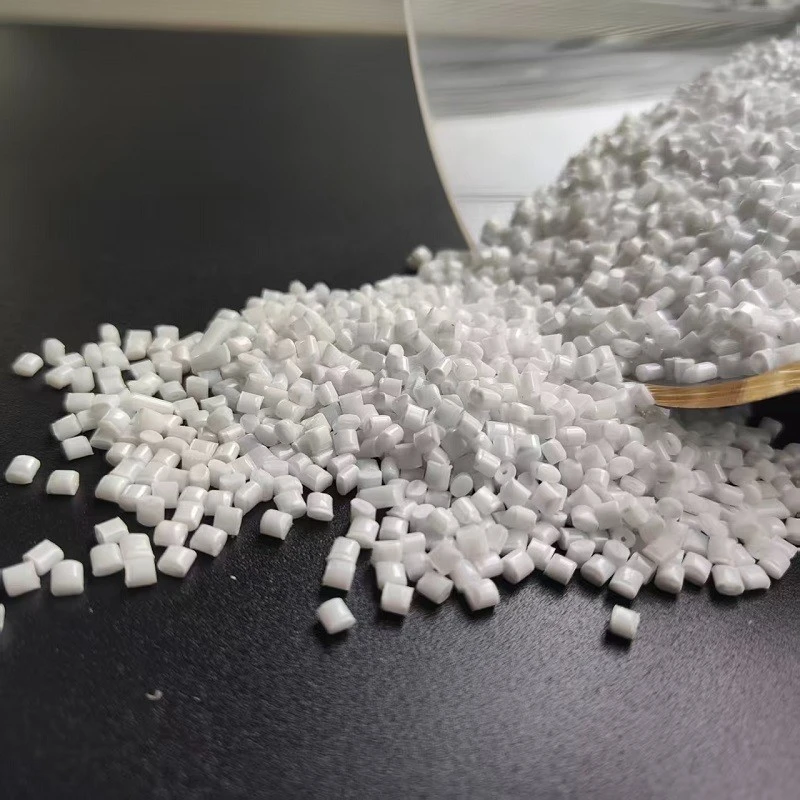

The strands are then cooled and cut into small pellets, which are the HIPS granules. The size and shape of the granules can be controlled by adjusting the die and the cutting mechanism.
Additives and Compounding
In some cases, we may add additives to the HIPS granules to enhance their properties. Additives can include antioxidants, UV stabilizers, flame retardants, and colorants.
Antioxidants are added to prevent the HIPS from oxidizing and degrading over time. UV stabilizers are added to protect the HIPS from the harmful effects of ultraviolet radiation. Flame retardants are added to make the HIPS more resistant to fire. Colorants are added to give the HIPS a specific color.
Compounding is the process of mixing the HIPS granules with the additives. Compounding is typically done using a twin-screw extruder. The twin-screw extruder has two screws that rotate in opposite directions, which helps to mix the HIPS granules and the additives evenly.
Quality Control
Throughout the production process, we conduct rigorous quality control checks to ensure that the HIPS granules meet our high standards. Quality control checks include testing the physical and chemical properties of the HIPS granules, such as the melt flow index, the impact strength, and the color.
We also conduct visual inspections to ensure that the HIPS granules are free from defects, such as cracks, voids, and discoloration. Any HIPS granules that do not meet our quality standards are rejected and recycled.
Types of HIPS Granules
As a supplier of HIPS granules, we offer a variety of different types of HIPS granules to meet the needs of our customers. Some of the types of HIPS granules we offer include:
- Flame Retardant HIPS Granules: These HIPS granules are formulated with flame retardants to make them more resistant to fire. They are commonly used in applications where fire safety is a concern, such as electrical enclosures and automotive parts.
- High Impact Polystyrene Granules: These HIPS granules are formulated with a higher amount of rubber modifier to enhance their impact resistance. They are commonly used in applications where impact resistance is a concern, such as toys and packaging.
- Opaque HIPS Granules: These HIPS granules are formulated with a pigment to make them opaque. They are commonly used in applications where a non-transparent appearance is desired, such as cosmetic containers and consumer goods.
Applications of HIPS Granules
HIPS granules are used in a wide variety of applications due to their excellent properties. Some of the common applications of HIPS granules include:
- Packaging: HIPS granules are commonly used in the production of packaging materials, such as food containers, trays, and blister packs. They are lightweight, durable, and have good barrier properties, making them ideal for protecting food and other products.
- Consumer Goods: HIPS granules are used in the production of a variety of consumer goods, such as toys, stationery, and household items. They are easy to process and can be molded into a variety of shapes and sizes, making them ideal for creating unique and attractive products.
- Automotive: HIPS granules are used in the automotive industry for a variety of applications, such as interior trim, dashboards, and door panels. They are lightweight, strong, and have good impact resistance, making them ideal for use in automotive applications.
- Electrical: HIPS granules are used in the electrical industry for a variety of applications, such as electrical enclosures, switches, and sockets. They are good insulators and have good flame resistance, making them ideal for use in electrical applications.
Contact Us for Procurement
If you're interested in purchasing HIPS granules for your business, we'd love to hear from you. We offer high-quality HIPS granules at competitive prices, and we can provide you with customized solutions to meet your specific needs. Whether you need a small quantity of HIPS granules for a prototype or a large quantity for mass production, we can help.
To learn more about our HIPS granules or to request a quote, please contact us. We look forward to working with you!
References
- "High Impact Polystyrene (HIPS): Properties, Processing, and Applications." Plastics Technology, https://www.plasticstechnology.com/articles/high-impact-polystyrene-hips-properties-processing-and-applications.
- "Styrene Monomer: Properties, Production, and Uses." Chemical Engineering, https://www.chemicalengineering.com/articles/styrene-monomer-properties-production-and-uses.
- "Emulsion Polymerization: Principles and Applications." Polymer Reviews, https://www.tandfonline.com/doi/full/10.1080/15583724.2018.1446874.